What Is an Ad Creative? Parts, Types and How to Check One
An ad creative is the part of an ad people see and hear: image or video, headline, text and call to action. Learn its parts, formats and how to check one.
Morpho Team · · 11 min read
An ad creative is the part of an ad that people actually see and hear: the image or video, the headline, the text on and around it, and the call to action. Targeting decides who gets the ad and the budget decides how often; the creative is what has to stop the scroll and make someone act. When marketers say "we need new creatives," they mean new versions of that visible part, not a new campaign.
What is an ad creative?
An ad creative is the finished, viewable unit of an ad: visual, copy and call to action together. On Meta, TikTok or Google you build a campaign, choose an audience and a budget, and then attach one or more creatives; the platform shows those creatives to the audience you picked. Our glossary entry for creative has the one-line version.
The word is used in two ways:
- One ad. "This creative is a 4:5 image with a discount headline."
- The craft. "Our creative is weak" means the ideas and design behind the ads, not one file.
Do not confuse the generic term with the tool AdCreative.ai, which many people search for with the same words. If you are comparing tools rather than learning the term, see our AdCreative.ai comparison.
What are the parts of an ad creative?
An ad creative has five parts that have to work together: the visual, the hook, the headline, the body text and the call to action. Each one has its own job, and a weak part usually drags the others down.
| Part | What it is | Its job |
|---|---|---|
| Visual | The image, video or carousel cards | Stop the scroll and show the product or the result |
| Hook | The first second of a video, or the first thing the eye lands on in an image | Earn the next three seconds of attention |
| Headline | The short, large line on the image or under it | State the main benefit in a few words |
| Body text (primary text) | The text above or beside the ad in the feed | Add the detail, proof or offer the headline could not fit |
| Call to action (CTA) | The button and any action line ("Shop now", "Book a demo") | Tell people exactly what to do next |
Two things sit around those parts: the brand (logo, colors, fonts, tone, so people know who is talking) and the format (the size and placement it was made for). A creative that is great in a feed can fail in Stories if its text sits where the app's buttons cover it.
Ad creative vs ad copy: what is the difference?
Ad copy is the words of an ad; the ad creative is the whole ad, including those words. The headline, body text and CTA are the copy; the creative is the copy plus the visual, the layout and the motion. So every creative contains copy, but copy alone is not a creative.
In practice the line blurs because the strongest ads are planned as one idea: the image shows what the headline promises. If you want to work on the words first, our ad copy examples cover headlines, primary text and CTAs with before-and-after rewrites, and the ad copy character counter checks lengths against platform limits.
What types of ad creatives are there?
The main ad creative types are static images, videos, carousels and collection or catalog ads. Which one you choose depends on what you sell, where the ad runs and how much you have to explain.
| Type | What it looks like | Good for | Watch out for |
|---|---|---|---|
| Static image | One still image with copy | Testing angles quickly; one clear offer | Must make its point in one frame |
| Video | 6 to 60 seconds, often vertical | Showing the product in use, telling a short story | The first seconds decide whether anyone stays |
| Carousel | Several swipeable cards in one ad | Several products, steps or features | The first card has to work alone |
| Catalog ad | Product images pulled from a product feed | Stores with many products and retargeting | Looks only as good as your product photos |
| UGC-style | Looks like a customer's own post or video | Trust and social proof | Must be real or clearly labeled; don't fake reviews |
Formats also differ by aspect ratio. Meta recommends 4:5 for Instagram feed images and 9:16 for Stories and Reels (see Meta's ad guide for Instagram feed and for Instagram Stories). Our ad image sizes page lists the sizes per platform in one place.
What makes a good ad creative?
A good ad creative makes one clear promise to one audience and is easy to read in the second or two people give it. That sounds simple; most weak ads break it by saying three things at once, hiding the product, or using text too small to read on a phone.
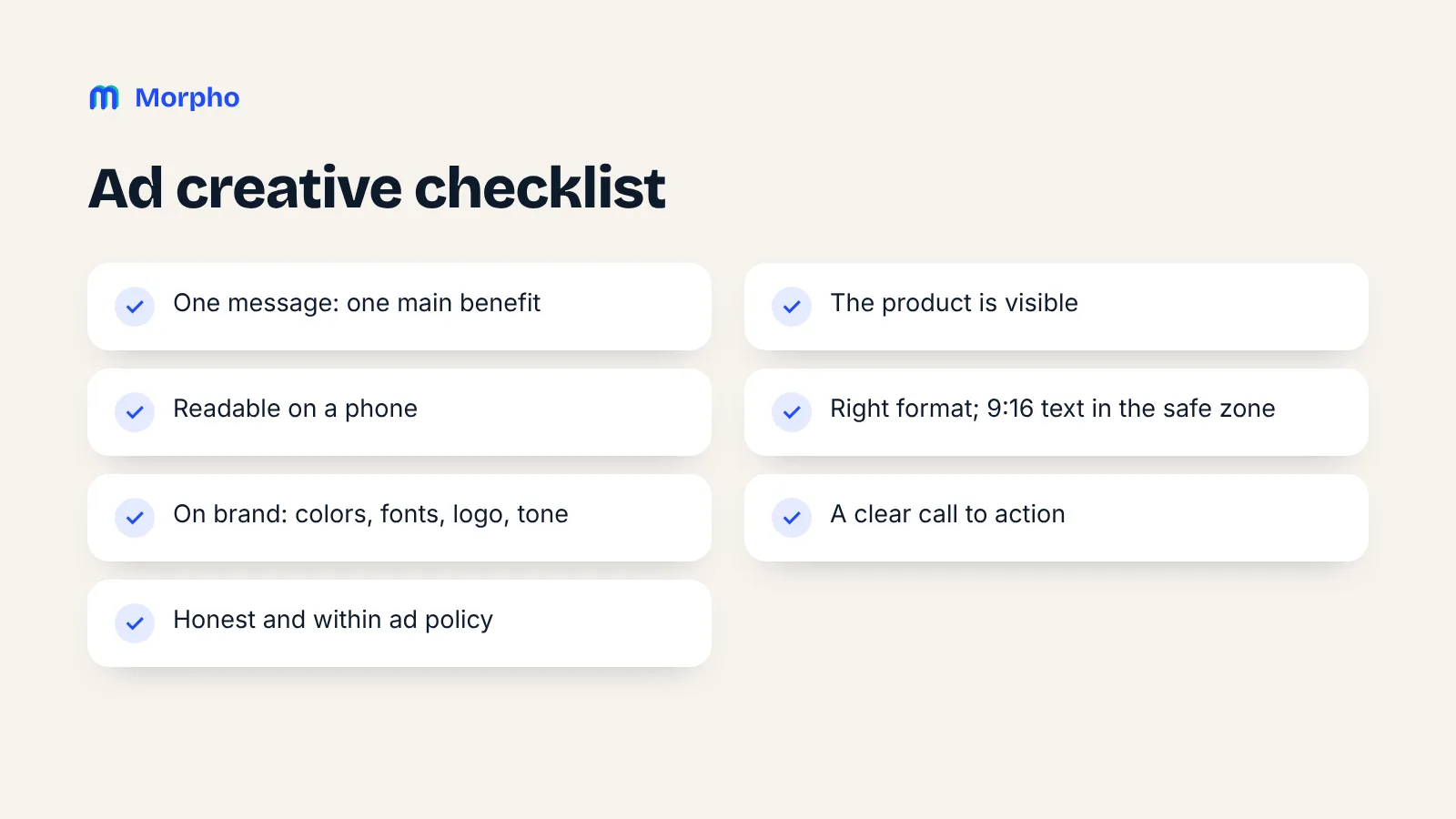
The qualities below are what experienced reviewers look for before an ad goes live:
- One message. One main benefit, not a list of features.
- The product is visible. People should know what is being sold without reading the body text.
- Readable on a phone. Short headline, large type, strong contrast between text and background.
- Made for the placement. Correct aspect ratio; in 9:16 the text, logo and CTA sit clear of the app's interface (see safe zone).
- On brand. Your colors, fonts, logo and tone, so the ad builds recognition instead of looking like a stock template.
- A clear next step. A CTA that matches the offer ("Shop the set", not "Learn more" on a sale).
- Honest and within policy. No claims you can't back, no fake buttons or notifications, nothing that singles out personal attributes. Meta lists what it rejects in its Advertising Standards.
How do you make an ad creative?
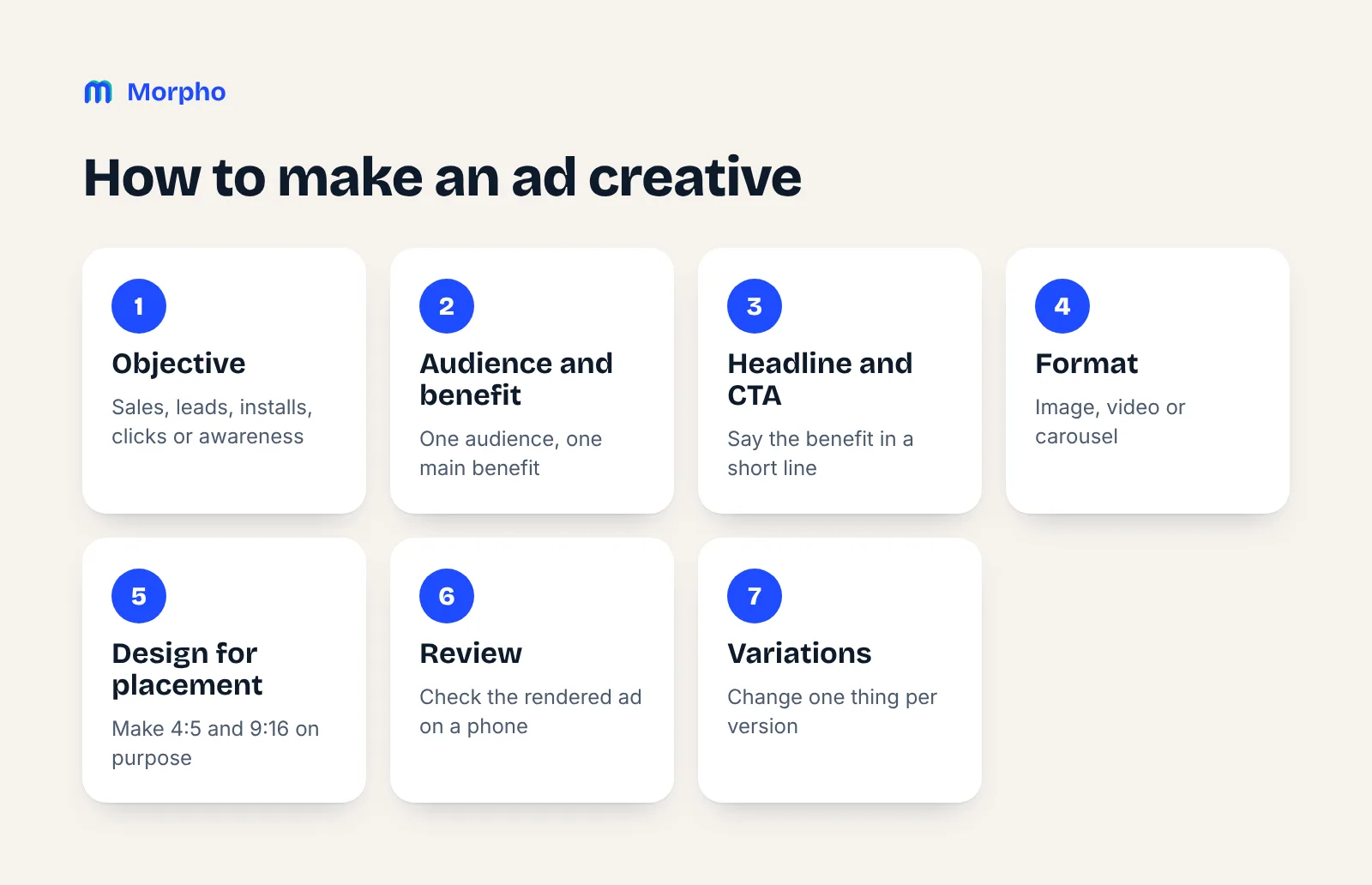
You make an ad creative by deciding the message first and the design second. Starting from a layout or a trend and filling in the words later is how ads end up pretty but vague. A simple order that works for small teams:
- Pick the objective. Sales, leads, app installs, clicks or awareness. It changes the CTA and how direct the ad should be.
- Pick one audience and one benefit. Your value proposition is where the benefit comes from. "Busy parents" and "ready in 10 minutes" beats "everyone" and "great quality".
- Write the headline and CTA. If you can't say the benefit in a short line, the design won't save it.
- Choose the format. A still image for a single offer, a video to show use, a carousel for several products.
- Design for the placement. Make the 4:5 and the 9:16 versions on purpose, not by cropping one into the other.
- Review before launch. Check it against the list above, on a real phone screen, ideally with someone who didn't make it.
- Make variations. Two or three versions that differ in one thing (the hook, the headline or the visual) so you can learn what works.
A short written creative brief that covers steps 1 to 4 saves most of the back-and-forth. For a walk-through of the design side, see our guide to AI ads.
How do you check an ad creative before it goes live?
You check an ad creative by reviewing the rendered ad, not the idea of it: look at the actual image or video at phone size and score it against fixed criteria. Most problems (text under a Reels button, a logo too small to see, a headline that wraps badly) only show up on the finished file.
A practical review loop:
- Use the same criteria every time. The seven qualities above are a good starting list. Scoring each one keeps feedback concrete ("CTA unclear") instead of vague ("doesn't pop").
- Ask for specific fixes. "Make the headline shorter and move it above the product" can be acted on; "make it better" can't.
- Repeat until it passes. Fix, re-render and check again. Keep the best version if a later round gets worse.
- Check policy last, every time. A small wording change can turn a fine ad into a rejected one.
This review loop is the step that most AI ad generators skip: they return whatever they made first. In Morpho Ads, a team of AI agents makes the ad, and a Critic agent looks at the rendered image, scores it on 7 criteria from 0 to 10 and sends concrete fixes back to the Art Director; the design and critique loop continues until the Critic approves, and the best round is kept. The Critic also checks every ad against Meta's most often hit ad rules, and a violation blocks approval. You can see how it works on the home page.
How do you test ad creatives?
You test ad creatives by running two or more versions that differ in one element to the same audience and comparing the results. Changing the headline, the visual and the offer all at once tells you that one ad won, but not why.
| What to test | Example variations | What you learn |
|---|---|---|
| Hook or first frame | Product close-up vs person using it | What stops the scroll |
| Headline | Price-led vs benefit-led | Which promise matters more |
| Format | Static image vs short video | Which format the audience responds to |
| CTA | "Shop now" vs "See the collection" | How ready people are to buy |
| Visual style | Studio photo vs lifestyle scene | What feels more trustworthy |
Meta has a built-in A/B testing tool in Ads Manager; read our A/B test entry for the basics. Give each test enough budget and time to reach a clear result before you judge it, and watch frequency: when the same people see an ad too often, results tend to drop, which is known as creative fatigue.
Who makes ad creatives?
Ad creatives are made by in-house designers, agencies, freelancers, and increasingly with AI tools. Each route trades off cost, speed and control differently, and many teams mix them.
- In-house team: knows the brand best; limited by people's time.
- Agency or freelancer: experienced eyes and polish; slower turnaround and higher cost per ad.
- Design tools with templates: cheap and fast if someone on the team can design.
- AI ad tools: fast volume; quality depends on whether the tool understands your brand and reviews its own output.
If you are weighing an agency against AI, our post on what an AI advertising agency is compares the options side by side. Morpho Ads sits in the AI group: you connect your brand by entering your website, Morpho drafts a brand kit (logo, colors, fonts, tone), and you ask for ads in a chat. It makes static ads in 4:5, 1:1 and 9:16 and videos in 9:16, 4:5, 1:1 and 16:9. Plans are on the pricing page.
FAQ
What is an ad creative in simple terms?
An ad creative is the ad itself as people see it: the picture or video, the words and the button. Everything else in a campaign, like the audience, budget and schedule, decides where and how often that creative is shown.
What is the difference between ad copy and ad creative?
Ad copy is only the text of an ad: headline, body text and call to action. The ad creative is the complete ad, which includes that copy plus the visual, the layout and, for video, the motion and sound.
How many ad creatives should I run at once?
There is no fixed number that is right for every account. A common approach is to start with a few variations that each change one element, so you can tell which change made the difference, and to replace them before the audience sees them too often.
Can AI make ad creatives?
Yes. AI tools can write the copy, design images and animate videos in the right sizes. Check the output the way you would check a designer's work: on a phone screen, against your brand and the platform's ad policies. Tools that review and revise their own designs before you see them save part of that work.
What size should an ad creative be?
It depends on the placement. For Instagram, Meta recommends 4:5 for feed images and 9:16 for Stories and Reels. Our ad image sizes page lists the current sizes for each platform.
This article was prepared with the help of AI; facts and sources were checked before publishing.
Make your ads in one conversation.
Connect your site and write what you need. An AI team makes on-brand image ads, videos and social media posts; you get the version that passed quality control.
Try it free