Ad copy examples: 20 templates that work
20 ad copy examples in 6 patterns, good vs bad rewrites, how to write ad copy step by step, character limits for Meta, Google and TikTok, and CTA ideas.
Morpho Team · · 11 min read
Good ad copy says one benefit in a short headline, backs it up with one concrete detail, and ends with one clear call to action (CTA). The 20 ad copy examples below show that structure in six patterns: benefit-first, problem and solution, question hook, offer and deadline, proof by detail, and lead generation for service businesses.
Every brand and product in the examples is made up. The point is the structure, not a sentence to copy. If you want the bigger picture (copy, design and video together), read our guide to making ads with an AI ads generator.
What is ad copy?
Ad copy is all the text people read in an ad: the headline, the primary text, the description and the CTA. In a social ad, part of it sits on the image itself and part of it sits in the fields above and below the image. For original slogans and ready-made ads by industry, see our ad copy examples by industry.
| Part | What it does | Where it shows |
|---|---|---|
| Headline | States the one benefit or offer | On the image and/or in the headline field under it |
| Primary text | Backs the benefit with a detail and makes clear who it's for | Above the image on Facebook and Instagram; under the video on TikTok |
| Description | Extra info: shipping, returns, options | Under the headline (not shown in every placement) |
| CTA | The single next step | The button, and often a line on the image |
What makes good ad copy?
Good ad copy is specific, short and honest: one reader, one benefit, one proof and one next step. Most weak ads fail on the first two, because they try to speak to everyone about everything.
Good vs bad ad copy examples
Comparing a weak and a strong version of the same ad is the fastest way to see the difference. Each fix below is a single change.
| Bad ad copy | Good ad copy | What changed |
|---|---|---|
| "The best coffee you'll ever taste!" | "Bergamot, lemon and jasmine. Ethiopia Yirgacheffe, roasted to order." | An unprovable claim became checkable detail. |
| "High-quality linen shirts for every occasion." | "The linen shirt that doesn't need ironing. 6 colors, sizes S to XXL." | A generic adjective became one benefit plus facts. |
| "Shop now, follow us and tag a friend!" | "Free returns for 30 days. Shop the fall collection." | Three asks became one CTA. |
| "Struggling with your weight?" | "A light lunch that keeps you full until dinner." | It no longer implies something about the reader (see the checklist). |
| "Innovative solutions for your business needs." | "Send invoices and track payments from one dashboard." | Buzzwords became what the product actually does. |
How to write ad copy (6 steps)
Writing ad copy means choosing what to say to whom, then making it as short and concrete as possible. These six steps work on any platform and in any industry.
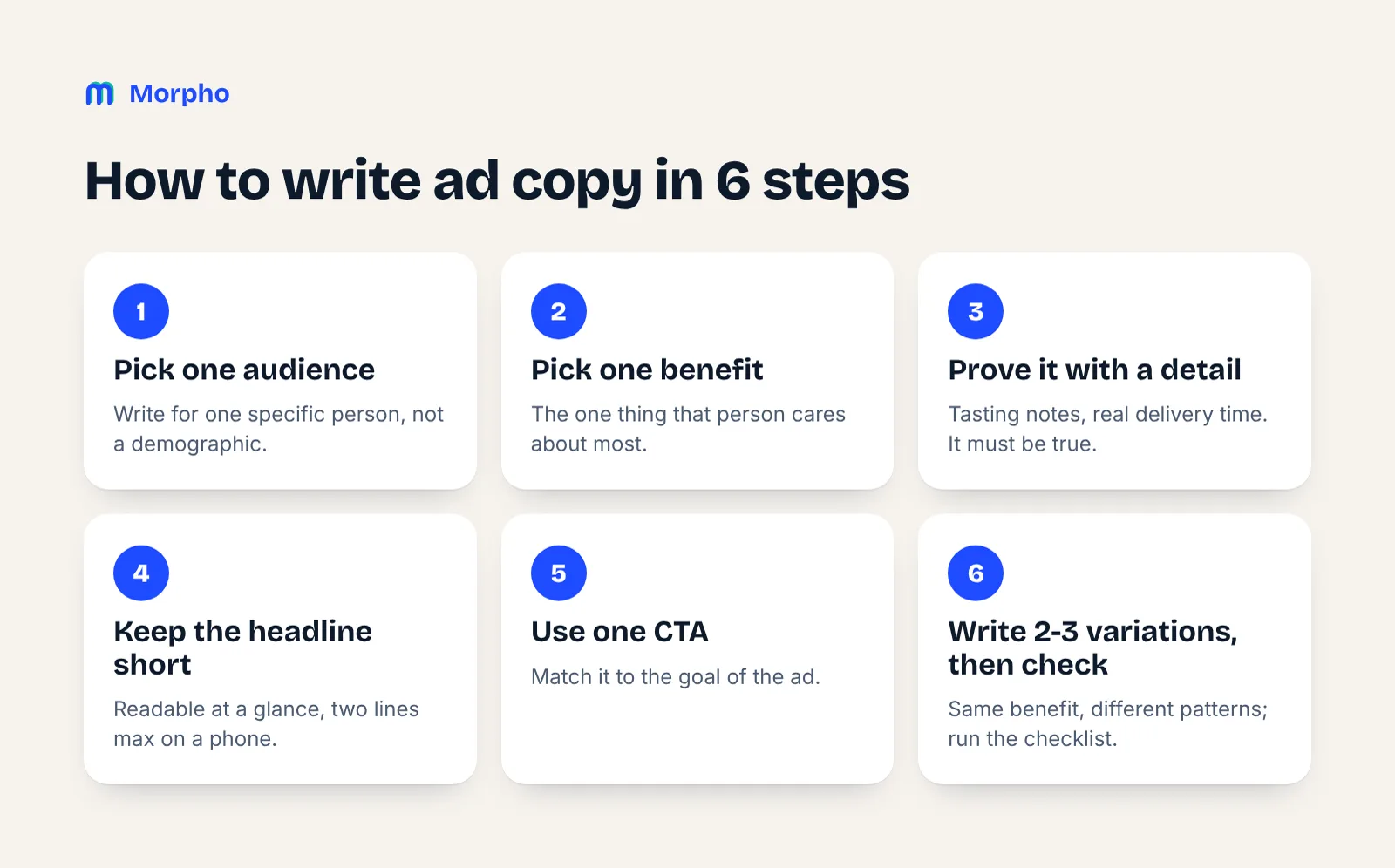
- Pick one audience. Write for one specific person, not a demographic.
- Pick one benefit. The one thing that person cares about most.
- Prove it with a detail. Tasting notes, real delivery time. It must be true.
- Keep the headline short. Readable at a glance, two lines max on a phone.
- Use one CTA. Match it to the goal of the ad (see the CTA table below).
- Write 2-3 variations, then check. Same benefit, different patterns from the list below; run the checklist.
Ad copy examples: 6 patterns, 20 examples
An ad copy pattern is a reusable structure for saying one benefit. Two or three patterns for the same product give you natural variations to test.
1. Benefit-first ad copy examples
A benefit-first ad says what the customer gets in the first sentence. It's the safest pattern to start with.
- Coffee: "Bergamot, lemon, jasmine. Ethiopia Yirgacheffe beans, roasted the day you order." CTA: Shop now
- Skincare: "One step for your morning routine: moisturizer and SPF in the same bottle." CTA: Learn more
- Apparel: "A linen shirt that stays smooth all day. 6 colors, sizes S to XXL." CTA: Shop now
- Furniture: "A standing desk you can set up in 10 minutes. The tools are in the box." CTA: See the desk
2. Problem and solution ad copy examples
This pattern names a situation the reader recognizes and offers the product as the fix. Describe the situation, not the person.
- Coffee: "Pour-over tasting bitter? The grind should match your brewer. Tell us how you brew and we'll grind for it." CTA: Choose your grind
- Bedding: "Sheets that shrink after the first wash? Ours are pre-washed cotton." CTA: Learn more
- Software: "Invoices scattered across folders? Create, send and track them from one dashboard." CTA: Try it free
3. Question hook ad copy examples
A question hook asks something your product answers, then answers it right away.
- Coffee: "Tired of the same morning cup? Get a different single-origin coffee every month." CTA: See the subscription
- Footwear: "On your feet all day? Try a memory-foam insole made for 12-hour shifts." CTA: Shop the styles
- Language course: "How much practice does it take to speak Spanish at work? Start with three live lessons a week." CTA: Take the level test
4. Offer and deadline ad copy examples
This pattern leads with a real, time-bound offer. Use it only for a discount or date that actually exists.
- E-commerce: "Until Sunday midnight: 20% off your second bag of coffee." CTA: Shop now
- Fashion: "End of season: free shipping on selected styles and free returns for 30 days." CTA: See the sale
- Event: "Early-bird registration closes October 15. Workshop seats are limited." CTA: Save your seat
5. Proof by detail ad copy examples
This pattern puts a checkable fact up front: material, size, origin or time. Don't invent statistics or "best" claims; a true detail persuades on its own.
- Coffee: "Grown at 1,900–2,200 meters and washed-processed. The roast date is printed on every bag." CTA: Read the details
- Jewelry: "Sterling silver, handmade, shipped in a gift box with a certificate." CTA: See the collection
- Baby products: "One-piece silicone, BPA-free, dishwasher safe." CTA: Learn more
6. Lead generation ad copy examples for service businesses
For services, the goal is not a purchase but the next step: a call, a quote or a form. Brands without a product catalog usually write this way.
- Agency or consultancy: "Let's review your website together in a free 20-minute call." CTA: Book a call
- Cleaning service: "Get a price for office cleaning the same day you fill in the form." CTA: Get a quote
- Education: "Weekend bookkeeping certificate. Download the syllabus, then decide." CTA: Download
- App: "A budgeting app that sorts your spending by category. First month free." CTA: Install now
Every number in these examples (discounts, setup times, altitudes) is made up. In your own copy, use only details that are true for your product.
How long should ad copy be? Character limits by platform
Short ad copy is copy that can be read without tapping "… more". Platforms accept long text, but feeds show only the first lines, so the main message belongs in the first sentence.
| Platform and field | Recommendation or limit | Source |
|---|---|---|
| Facebook Feed, primary text | 50–150 characters recommended | Meta Ads Guide: Facebook Feed |
| Facebook Feed, headline | 27 characters recommended | Meta Ads Guide: Facebook Feed |
| Instagram Feed, primary text / headline | 125 / 40 characters recommended | Meta Ads Guide: Instagram Feed |
| Google responsive search ad | Headlines up to 30 characters (up to 15), descriptions up to 90 (up to 4) | Google Ads Help |
| TikTok ad caption (TopView, Spark Ads Push) | Up to 100 characters; at most 4 lines show in the feed | TikTok Ads Help |
Google mixes your headlines, so each must make sense alone. On social, the headline on the image should add to the one under it, not repeat it. You can check a draft against these limits with our free ad copy character counter.
Which CTA should you use?
A CTA (call to action) is the short phrase that tells the reader the one thing to do next. The right CTA matches the ad's goal: "Shop now" for sales, "Get a quote" for leads.
| Ad goal | CTA examples |
|---|---|
| Sales | Shop now, Buy now, Add to cart |
| Traffic | Learn more, See the product, Read the details |
| Leads | Get a quote, Book a call, Sign up |
| App installs | Install now, Try it free |
| Awareness | Watch our story, Explore the collection |
On Meta and TikTok you pick the button text from a fixed list; the CTA written on the image or video is up to you. Make both point to the same step.
Ad copy checklist: mistakes to catch before launch
Most ad copy mistakes come from saying too much at once or making claims you can't back up. Run every variation through this list:
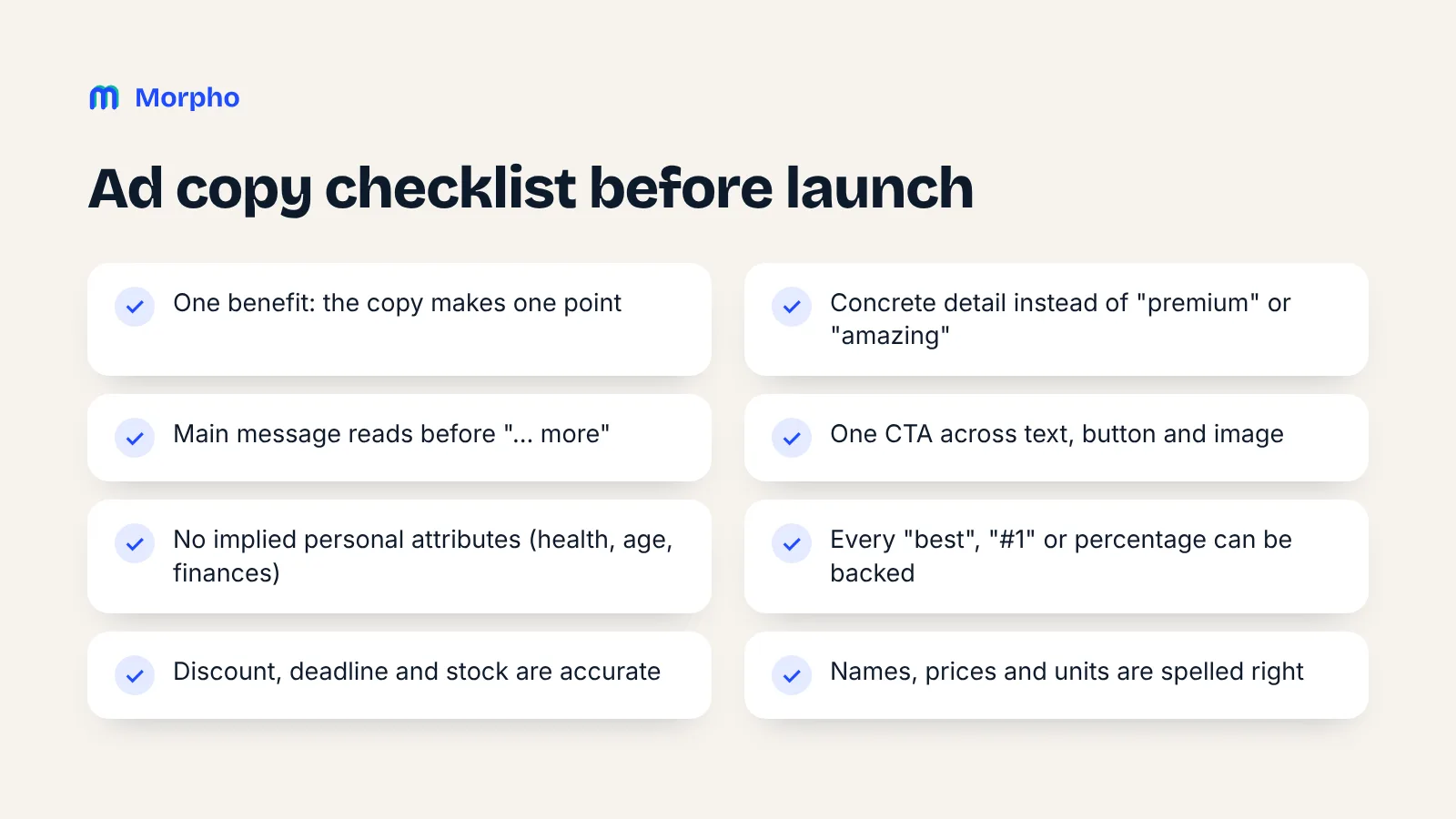
- One benefit: the copy makes one point.
- Concrete detail instead of "premium" or "amazing".
- Main message reads before "… more".
- One CTA across text, button and image.
- No implied personal attributes (health, age, finances).
- Every "best", "#1" or percentage can be backed.
- Discount, deadline and stock are accurate.
- Names, prices and units are spelled right.
The personal attributes point comes from Meta's advertising standards, which don't allow ads to assert or imply things like a person's health, age, beliefs or financial status. Write "A light lunch that keeps you full" instead of "Struggling with your weight?".
Can AI write ad copy?
Yes, AI can write ad copy, but it only writes good copy when you give it your brand, real product facts and one benefit to focus on. Without them it tends to produce generic lines or claims that aren't true, so the checklist above still applies to every AI-written draft.
In Morpho, copy isn't a separate task; it's part of the ad. Morpho is an AI ad team that makes static ads and videos for your brand, and you only talk to its Morpho:
- You connect your website. Morpho drafts your brand kit (logo, colors, fonts, tone of voice); the copy follows that tone.
- The Strategist picks the angle. It reads the product page and your site and chooses the one benefit, much like picking a pattern above.
- The Copywriter writes. Headline, sub-line, small info chips and the CTA; for videos, the scene-by-scene script.
- The Art Director designs and the Critic scores. The Critic looks at the finished ad, scores it on 7 criteria and asks for concrete fixes; the loop continues until it approves.
- You can change the words yourself. Click any text to edit it, or ask Morpho to "shorten the headline"; earlier versions are kept.
You can watch every step live in Morpho; the whole flow is in How it works. On the free plan, brand setup, the brand kit and one static ad or one video are included; see pricing for the rest. Morpho doesn't publish to Meta yet: you download the PNG or MP4 and run it from your own ad account.
FAQ
What is an example of good ad copy?
"Bergamot, lemon and jasmine. Ethiopia Yirgacheffe, roasted to order. Shop now." It names one benefit (the flavor), proves it with a checkable detail (origin and roasting) and asks for one action. The same structure works for any product.
How long should ad copy be?
As short as it can be while still saying one benefit and one detail. Meta recommends 50–150 characters of primary text and a 27-character headline for the Facebook Feed; Google caps search ad headlines at 30 characters. Put the main point in the first sentence either way.
Can I write ad copy with AI for free?
Many AI tools offer some free use, enough to draft a few variations. The output is only as good as the facts you give it, so check every line before you publish.
This article was prepared with the help of AI; facts and sources were checked before publishing.
Make your ads in one conversation.
Connect your site and write what you need. An AI team makes on-brand image ads, videos and social media posts; you get the version that passed quality control.
Try it free