AI Agents for Marketing: Types, Uses and How to Choose
What AI agents for marketing are, the main types (content, ads, campaigns, social, research), how a multi-agent ad team works and how to pick one safely.
Morpho Team · · 9 min read
AI agents for marketing are AI systems that take a marketing goal, plan the steps and carry them out with tools, instead of answering one prompt at a time. A content agent drafts posts from your brand data, a campaign agent builds and adjusts campaigns inside the rules you set, and an ad creative team of agents writes, designs and reviews ads before you see them. You still set the goal, approve what goes out and own the results.
What are AI agents for marketing?
An AI agent for marketing is software that works toward a marketing outcome on its own: it decides the next step, uses tools (your website, CRM, ad account, design canvas) and checks its own output. That is the difference from a chatbot or a generator, which wait for your next instruction.
IBM describes the everyday use plainly: "Marketers use AI agents as intelligent copilots to manage tasks that would otherwise require manual effort." In practice an agent has four parts:
- A goal ("two ads for the new product", "a week of social posts", "keep this campaign under budget").
- Context: your brand kit, product pages, past work and data it is allowed to read.
- Tools it can call: search, a design renderer, a CRM, an ad platform API, an MCP connector to another app.
- A check: a rule, a score or a second agent that reviews the work before it moves on.
Some products use one agent per job. Others use several agents with separate roles that hand work to each other, like a small team.
What types of AI marketing agents are there?
Marketing agents are usually sorted by the job they own. The table lists the common types, what each one does and an example of how a vendor describes its own product.
| Agent type | What it does | What it touches | Example (vendor's own description) |
|---|---|---|---|
| Content agent | Drafts blogs, landing pages and other long copy in your brand voice | Your CMS, brand docs | HubSpot's Breeze Content Agent "generates high-quality content like landing pages, podcasts, blogs, and case studies" (HubSpot) |
| Social media agent | Reviews your social presence and drafts posts for approval | Social accounts | Breeze Social Media Agent "analyzes a brand's social presence and creates posts" (same source) |
| Campaign agent | Builds, runs and tunes campaigns within rules you set | Marketing cloud, ad accounts, budgets | Salesforce calls Campaign Agent "your digital campaign manager, doing the work for you within guardrails you set" (Salesforce) |
| Ad creative agents | Write and design static and video ads; some add a review step | Brand kit, product photos, design tools | Generators such as AdCreative.ai and Pencil make ad creatives from your brand assets |
| Agent builders | Let you assemble your own agents for single tasks | Whatever you connect | Relevance AI offers pre-scoped agents where "each agent owns one marketing task, works from your brand and your data" (Relevance AI) |
| Research and analysis agents | Summarize competitor ads, reviews, reports and results | Ad libraries, analytics, your files | Often a role inside a larger product rather than a product of its own |
The same company can sell several of these. Read what an agent is actually allowed to touch: drafting a post and publishing it are very different permissions.
What can AI agents do for marketing teams?
AI agents are most useful for marketing work that repeats, has a clear standard and can be checked before it ships. Good fits:
- Steady creative volume: new ad sizes, fresh angles for a product, weekly social posts. See our guide to what ad creative is for the parts an agent has to get right.
- First drafts of copy: headlines, primary text and CTAs to edit, not to publish blind. Our ad copy examples show what good looks like.
- Pre-flight checks: text inside the safe zone, character limits (ad copy counter), wording that tends to trip ad policies (Meta ad policy checker).
- Research summaries: what competitors are running (the competitor ads finder opens the official ad libraries), what a report says, what changed since last week.
- Reporting: turning numbers you already have into a readable summary.
Weak fits are judgment calls with real risk: legal and health claims, crisis replies, pricing decisions, and anything that spends money or posts publicly without a person approving it.
What does an AI creative team of agents for ads look like?
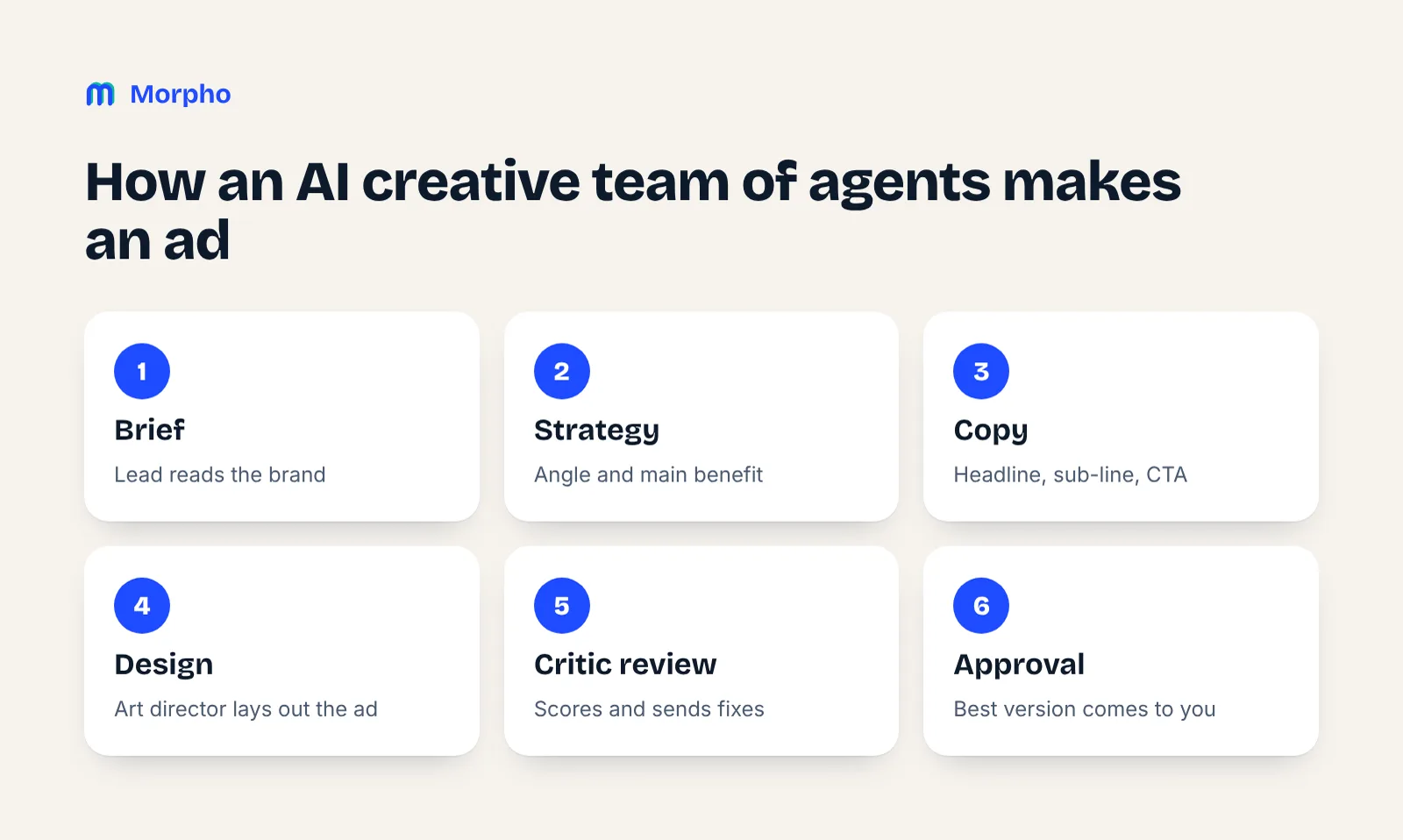
An AI creative team for ads is a set of agents that split one ad request into the roles a human agency would use, then review the result before you get it. A typical team:
| Role | Job in the team |
|---|---|
| Lead (account or creative director) | Talks to you, reads the brand and decides who does what |
| Strategist | Picks the angle and the main benefit to lead with |
| Copywriter | Writes the headline, sub-line and call to action, or the video script |
| Art director | Lays out the static ad or animates the video in the right format |
| Critic | Looks at the finished design, scores it and sends concrete fixes back |
| Consultants | Answer narrow questions: competitor ads, targeting ideas, a channel |
The part that matters most is the loop between the art director and the critic. A single generator returns its first attempt; a team with a critic keeps revising until the design passes, which is where unreadable text, a buried CTA or an off-brand color gets caught. We wrote about that review step in more detail in ad creative analysis, and about the wider category in what an AI advertising agency is.
Are AI marketing agents worth it? The risks to plan for
AI marketing agents are worth it when the time they save is larger than the time you spend checking them, and that depends on the job. Analysts are cautious: Gartner predicted in June 2025 that over 40% of agentic AI projects will be canceled by the end of 2027, while also expecting at least 15% of day-to-day work decisions to be made autonomously through agentic AI by 2028, up from 0% in 2024.
The risks that come up most in marketing:
- Off-brand or wrong output when the agent has thin context. Give it a brand kit and real product pages, not a one-line prompt.
- Unchecked publishing. Keep a human approval step before anything goes live or spends budget.
- Invented facts. Agents can write claims, prices or reviews that aren't true. Anything factual needs a source you can check.
- Prompt injection. An agent that reads web pages, comments or emails can be steered by text hidden in them. Treat outside content as data, and limit what the agent may do on its own.
- Unclear cost. Usage-based pricing is fair but hard to predict; ask for an estimate before a job starts.
How to choose an AI agent for marketing
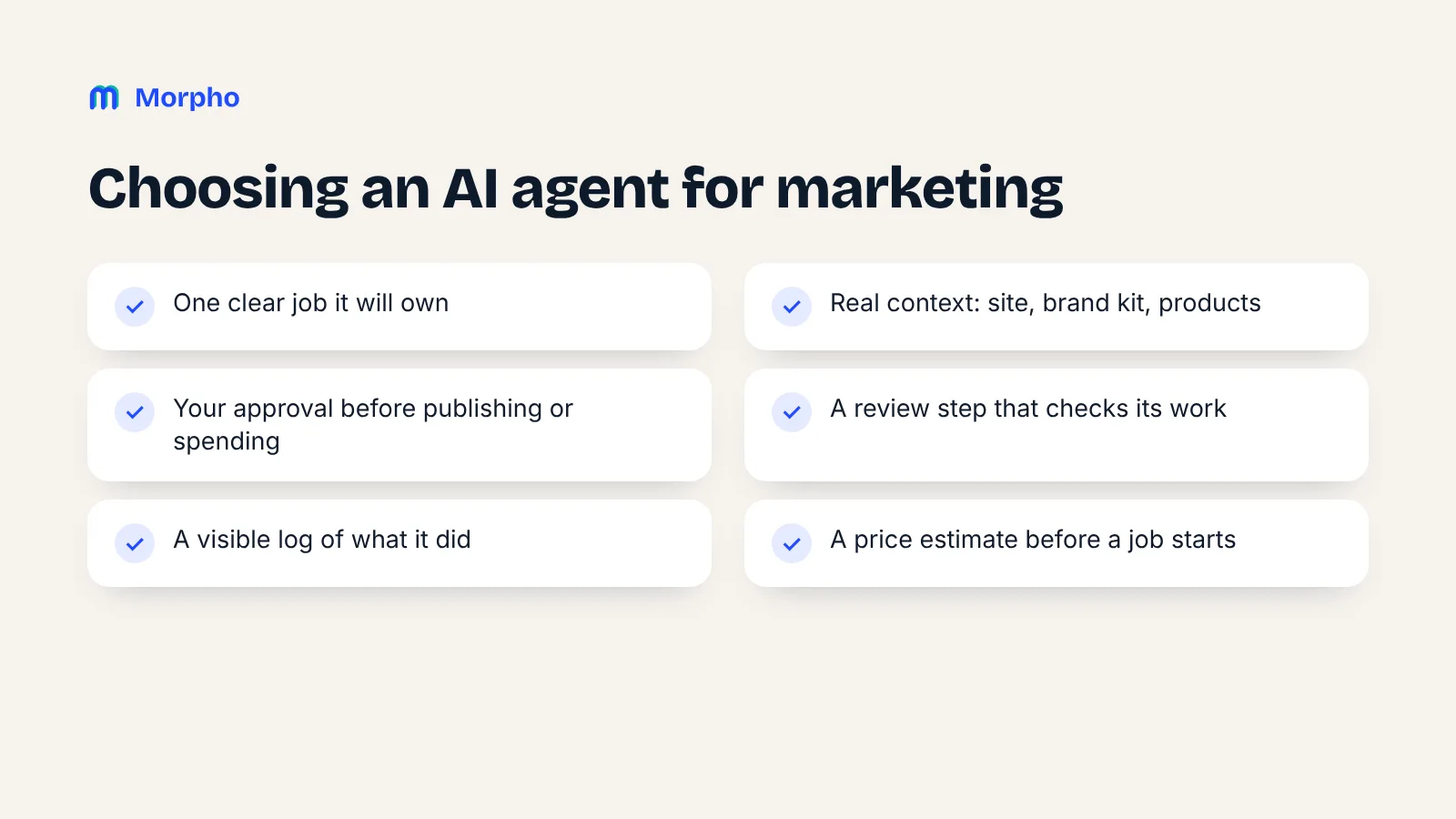
Choose by the job first and the vendor second. These six questions sort most options quickly:
- Which job will it own? Content, ads, campaigns, social or research. One clear job beats "does everything".
- What does it read? Your site, brand kit, product feed, past work, analytics. More real context means less editing.
- What can it do without you? Draft only, or also publish, spend or email? Ask for the exact permissions.
- How does it check its own work? A score, a reviewer agent, policy checks, or nothing.
- Can you see what it did? A visible log of steps and decisions makes mistakes easy to find.
- How is it priced? Seats, subscription or usage, and whether you get an estimate before a job.
Where Morpho Ads fits, and where it doesn't
Morpho Ads is a team of AI agents for ad creative. You talk to one agent, Morpho (the agency lead), in a chat; it researches the brand and hands the work to a strategist, copywriter, art director and critic, with consultants such as a researcher for competitor ads and a digital ads specialist. The critic scores every design on 7 criteria and asks for fixes until it approves, and every step shows live in the activity feed. It makes static ads in 4:5, 1:1 and 9:16 and videos in 9:16, 4:5, 1:1 and 16:9, keeps text and logos out of the Reels, Stories, TikTok and Shorts interface areas, and checks ads against Meta's most-often-hit ad rules before approval.
What it doesn't do, so you can compare fairly:
- It doesn't publish or run ads. Sending a paused draft to Meta Ads Manager is built but switched off until Morpho's Meta app is approved.
- No performance tracking or fatigue detection yet. It can't tell you which live ad is winning.
- Ads and posts only. It is not a CRM, email, SEO or customer-service agent; for those, the content and campaign agents above are the right category.
Chatting with Morpho uses a weekly allowance rather than credits; making ads costs credits by real usage. You can see how it works and the plans, and Morpho can also be added to Claude as an MCP connector.
FAQ
What is the difference between an AI agent and an AI tool?
An AI tool does one thing when you ask, such as generating an image from a prompt. An AI agent works toward a goal: it plans steps, uses tools and checks results before moving on. Many products mix both, so look at what happens between your request and the result.
Can AI agents replace a marketing team?
Not for the decisions that carry risk: strategy, budget, legal claims and what goes public. They can take a large share of the repeat work, like drafts, sizes, versions and summaries, so the people on the team spend more time deciding and less time producing.
What are the best AI agents for marketing?
It depends on the job. For content and CRM-heavy work, agents inside a marketing platform you already use are the simplest start; for ad creative, look for agents that read your brand kit and review their own designs; for custom workflows, an agent builder. Compare them on the six questions in the checklist above.
Can I build my own AI agents for marketing?
Yes. Agent builders let you assemble single-task agents and connect them to your tools, and assistants like Claude can use outside apps through MCP connectors. Building takes setup and testing time, so it suits teams with a repeatable process and someone to maintain it.
Are AI marketing agents safe to use?
They are as safe as the permissions you give them. Keep approval before publishing or spending, give them only the data they need, check every factual claim, and treat text they read from the web or inboxes as data, not instructions.
This article was prepared with the help of AI; facts and sources were checked before publishing.
Make your ads in one conversation.
Connect your site and write what you need. An AI team makes on-brand image ads, videos and social media posts; you get the version that passed quality control.
Try it free