Ad Creative Analysis: Review Ads Before and After Launch
Ad creative analysis means checking an ad's visual, copy and CTA before launch, then comparing its results after. A 7-step checklist and the tools that help.
Morpho Team · · 10 min read
Ad creative analysis is the habit of looking hard at an ad's visual, copy and call to action to find what works and what to fix. It happens twice: before launch, when you read the ad against a checklist and catch problems for free, and after launch, when you compare its results with other creatives shown to the same audience. Most teams only do the second half, which means they pay to discover mistakes a five-minute review would have caught.
This guide covers both halves, with a seven-step pre-launch checklist, the numbers worth reading after launch, and a neutral look at the tools that help, including AI critics that review and revise an ad until it passes.
What is ad creative analysis?
Ad creative analysis is the review of an ad's visible parts (image or video, headline, on-image text and CTA) to judge whether it can do its job. If you need the basics first, our post on what an ad creative is explains the parts and formats, and the glossary has a one-line definition of creative analysis.
The two stages answer different questions:
| Stage | Question it answers | What you look at | When it is useful |
|---|---|---|---|
| Pre-launch review | "Will people understand this ad in a second, and is it allowed to run?" | The rendered image or every frame of the video, the copy, the placement | Always; it costs nothing but time |
| Post-launch analysis | "Which of my live creatives works best for this audience?" | Platform results per creative: CTR, hold rate, CPA, ROAS | Only after each creative has had enough impressions |
Targeting and budget decide who sees an ad and how often. The creative decides whether they stop. That is why it deserves its own review rather than being judged only by campaign totals.
How do you analyze an ad creative before launch?
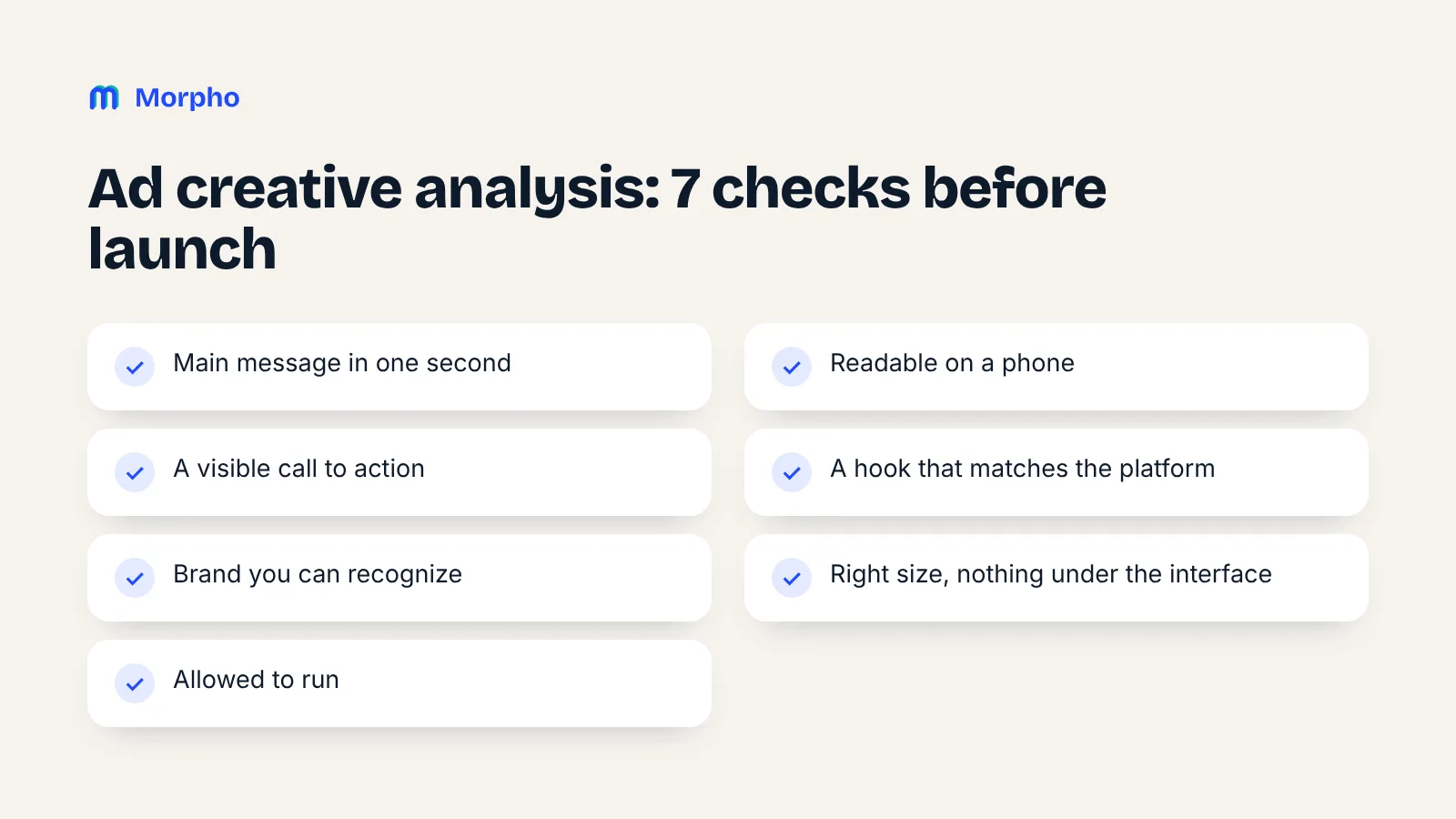
You analyze an ad before launch by viewing it the way a customer will, on a phone, at full speed, and checking it against a fixed list of questions. Open the ad on a real phone, not a large monitor, and scroll past it once at normal speed. Then go through the list below, in order, and write down every "no".
- Main message in one second. Cover the small print. Can someone say what the ad offers after a glance? One idea per ad; two competing messages usually means neither lands.
- Readable on a phone. Text is large, short and stands out from the background. Thin fonts over busy photos are the most common failure.
- A visible call to action. The next step ("Shop the set", "Book a demo") is written out and looks tappable. A CTA hidden in a corner does little.
- A hook that matches the platform. For video, the first seconds show the product or the problem, not a slow logo intro. See hook for examples.
- Brand you can recognize. Logo, colors and type match the rest of your marketing, so people who saw you before recognize you again.
- Right size, nothing under the interface. The aspect ratio fits the placement, and in 9:16 the text, logo and CTA sit clear of the app's buttons and captions. Our safe zone checker draws the Instagram Reels, Stories and TikTok interface over your image and marks any text or logo under it in red.
- Allowed to run. No claims you cannot prove, no copy that points at a person's personal attributes ("Are you overweight?"), no fake buttons or interface. Meta's Advertising Standards are the source; our Meta ad policy checker flags the most common problems in your copy.
Fix the lowest-scoring item first. In practice, one or two changes (bigger headline, CTA moved up, price moved out of the bottom of a 9:16 frame) fix most of what the review finds.
What should you score an ad creative on?
Score an ad creative on a short list of criteria, each from 0 to 10, so problems become comparable instead of a vague "I don't love it". Five criteria cover most static ads, and they are the ones our free ad score tool uses:
| Criterion | What a high score looks like | What a low score looks like |
|---|---|---|
| Readability | Large, high-contrast text with few words | Small or thin text over a busy photo |
| Main message | One clear idea at first glance | Several messages competing |
| Call to action | Explicit, visible next step | No CTA, or one that blends in |
| Brand consistency | Logo, colors and type work together | Looks like it could be anyone's ad |
| Platform fit | Right ratio, clear of the interface, made for a phone | Desktop layout squeezed into 9:16 |
A score is a review, not a forecast. It does not know your offer, targeting, budget or landing page, all of which shape results. Use it to decide what to fix before launch, and let real results decide between the ads that pass.
How do you analyze ad creative performance after launch?
After launch, you analyze creative performance by comparing creatives against each other inside the same campaign and audience, using the metric that matches your goal. Comparing an ad that ran to warm retargeting audiences with one that ran to cold audiences tells you about the audiences, not the creatives.
| Metric | What it tells you about the creative | Read it for |
|---|---|---|
| CTR | Did the ad make people click? | Traffic and sales ads |
| Hold rate | Did people keep watching past the opening? | Video ads |
| CPA | What one result cost through this ad | Lead and sales ads |
| ROAS | Revenue per unit of spend | Sales ads with purchase tracking |
| Frequency | How often the same people saw it | Spotting creative fatigue |
Three rules keep the reading honest:
- Wait for enough impressions. Early numbers swing a lot. Judge only once each creative has had a fair share of budget and time.
- Change one thing per test. If the new ad has a new image, headline and offer, a win tells you nothing about which change mattered. Meta's built-in A/B testing splits the audience for you; our A/B test entry covers the basics.
- Write down why. Next to each result, note what the creative did differently (the angle, the hook, the format). That note is what turns one winning ad into the next brief.
To compare CTR, CPC and CPM across ads quickly, use the CTR calculator; for revenue, the ROAS calculator.
What are ad creative analysis tools, and which kind do you need?
Ad creative analysis tools fall into four groups, and they answer different questions. Pick the one that matches the half of the job you are missing.
| Type of tool | What it does | Strength | Weakness | Fits |
|---|---|---|---|---|
| Manual checklist (like the one above) | You review each ad yourself | Free; you learn your own patterns | Slow; easy to skip when busy | Small teams, few ads a week |
| Single-pass AI scoring | Upload an image, get scores and tips | Fast, consistent second opinion | Reviews only; you still make the fixes | Checking ads made elsewhere |
| Generation with a critic loop | An AI critic reviews each design and sends it back until it approves | The review is built into making the ad | Only covers ads made in that tool | Teams that want finished, reviewed ads |
| Performance analytics platforms | Pull live results per creative from the ad accounts | Shows what really worked | Needs spend and data first; says little before launch | Accounts with many live creatives |
Most teams need one pre-launch option and one post-launch option. Ads Manager's own reports cover a lot of the post-launch side for free before you add a dedicated analytics platform.
Is there an AI ad tool where a critic reviews the ad until it is approved?
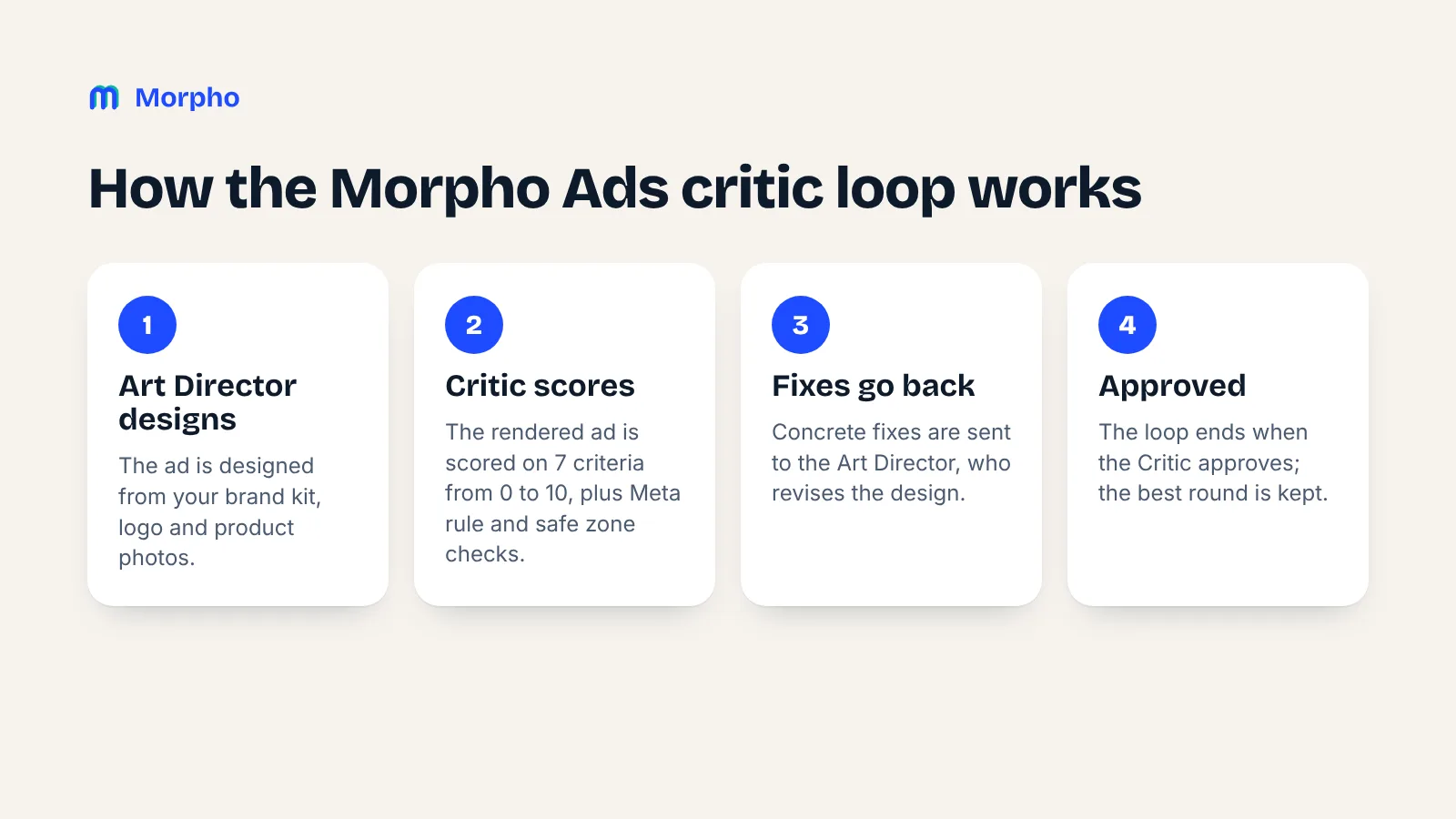
Yes. Morpho Ads is an AI ad tool that works this way: a team of AI agents makes the ad, and a Critic agent reviews it before you get it. The Critic looks at the rendered image, scores it on 7 criteria from 0 to 10 and asks for concrete fixes; the Art Director revises, and the design and critique loop continues until the Critic approves. If the score stalls, the Art Director starts a fresh layout, and the best round is kept.
The same review covers the rules side of the checklist. The Critic checks every ad against the Meta ad rules that are broken most often (personal attributes, unproven claims, fake interface, invented contact details) and the extra rules of sensitive categories such as health, finance or alcohol; a violation blocks approval. A brand's banned phrases are checked in code, so an ad containing one cannot be approved. For 9:16 ads, text, logo and CTA must stay clear of the Reels, Stories, TikTok and Shorts interfaces, and every video frame is measured, not only the first.
Every round's score and notes stay with the creative, so you can see why an ad was changed. You can read how it works on the home page or see the plans on the pricing page. Morpho does not run your ads or track their live results today, so the post-launch half above still happens in your ad account.
How often should you analyze your ad creatives?
Review every new creative before it goes live, and look at live creative performance on a fixed schedule, for example once a week. A weekly look is often enough to spot rising frequency and falling CTR, the usual signs of creative fatigue, before costs drift for long. When a creative tires, keep the winning idea and refresh the visual, hook or copy rather than starting from zero.
FAQ
What is creative analysis in advertising?
Creative analysis is reviewing an ad's visual, copy and call to action to find what works and what to fix. Before launch it means checking the ad against a checklist; after launch it means comparing its results with other creatives shown to the same audience.
Can AI analyze ad creatives?
Yes. AI tools can score an ad image on criteria such as readability, main message and CTA, and suggest fixes; some, like Morpho Ads, build that review into making the ad. AI scores are a review, not a prediction of results, so live performance still decides between ads that pass.
What is the difference between creative analysis and creative testing?
Creative analysis is the review itself, before and after launch. Creative testing is the controlled experiment after launch, where two or more creatives run to the same audience and the results decide the winner. Analysis tells you what to test next.
Which metrics matter most in ad creative analysis?
It depends on the goal: CTR for traffic, hold rate for video, CPA for leads and sales, and ROAS when purchases are tracked. Watch frequency too, because rising frequency with falling CTR usually means the creative is tiring.
Is there a free ad creative analysis tool?
Yes. Our free ad score tool scores an ad image from 0 to 10 on five criteria and gives up to three tips, without sign-up; the image is not stored. The safe zone checker and Meta ad policy checker cover placement and rules.
This article was prepared with the help of AI; facts and sources were checked before publishing.
Make your ads in one conversation.
Connect your site and write what you need. An AI team makes on-brand image ads, videos and social media posts; you get the version that passed quality control.
Try it free