Creative Brief Template for Ads (Free, With Example)
A free creative brief template for ads: nine fields to copy, a filled-in example for a Meta and TikTok campaign, and how to write a brief in seven steps.
Morpho Team · · 10 min read
A creative brief template is a one-page form that tells the people making an ad what to make, for whom and why, before any design starts. For an ad, it needs nine fields: objective, audience, the problem, one main message, proof, the call to action, format and placements, mandatories, and the deadline with the approver's name. Copy the template below, fill one field per line, and get it signed off before the first draft.
What is a creative brief?
A creative brief is a short direction document that sums up what an ad will say, to whom, with which message and in which format. The marketer or account lead writes it; the copywriter, designer or video editor works from it; the approver checks the finished ad against it.
It is the cheapest place to fix a wrong idea. Changing a line in a brief takes a minute. Changing a finished video because the audience was wrong takes a new shoot or a new edit. That is why most creative approval workflows put the brief first: the client says yes to the direction, then the team makes the ad.
A creative brief is also narrower than a marketing plan. It covers one ad, one set of ads or one campaign, and it fits on a single page. If yours runs to five pages, the team will skim it and miss the one sentence that mattered.
Creative brief template (copy and fill)
A creative brief template for ads, in short, is nine questions with one answer each. Here is the version we use for paid social and search ads. Copy it into a doc, a ticket or a chat message.
CREATIVE BRIEF

1. Objective: What should the viewer do after seeing the ad? (buy, sign up, install, visit, remember)
2. Audience: Who exactly sees this? What do they already know about us?
3. Problem: What gets in their way today, in their own words?
4. Main message: The one thing they should remember. One sentence.
5. Proof: Why should they believe it? (a feature, a demo, a guarantee, a real review)
6. Call to action: The exact button or line. ("Shop now", "Book a demo")
7. Format and placements: Sizes, length, platforms. (4:5 feed, 9:16 Reels/TikTok, 15 s video)
8. Mandatories: Logo, legal lines, prices, words we must or must never use.
9. Deadline and approver: Due date, and the one person who signs off.
What each field is for:
| Field | What to write | Question it answers |
|---|---|---|
| Objective | One action, matching the campaign objective | What counts as success? |
| Audience | A specific person and situation, not "women 25–45" | Who are we talking to? |
| Problem | The obstacle in the customer's words | Why would they care now? |
| Main message | One sentence, one benefit (the key message) | What is the single takeaway? |
| Proof | A fact the ad can show | Why believe it? |
| Call to action | The exact CTA text | What happens next? |
| Format and placements | Aspect ratios, length, platforms | Where will it run? |
| Mandatories | Must-haves and never-use words | What can't change? |
| Deadline and approver | A date and a name | When, and who decides? |
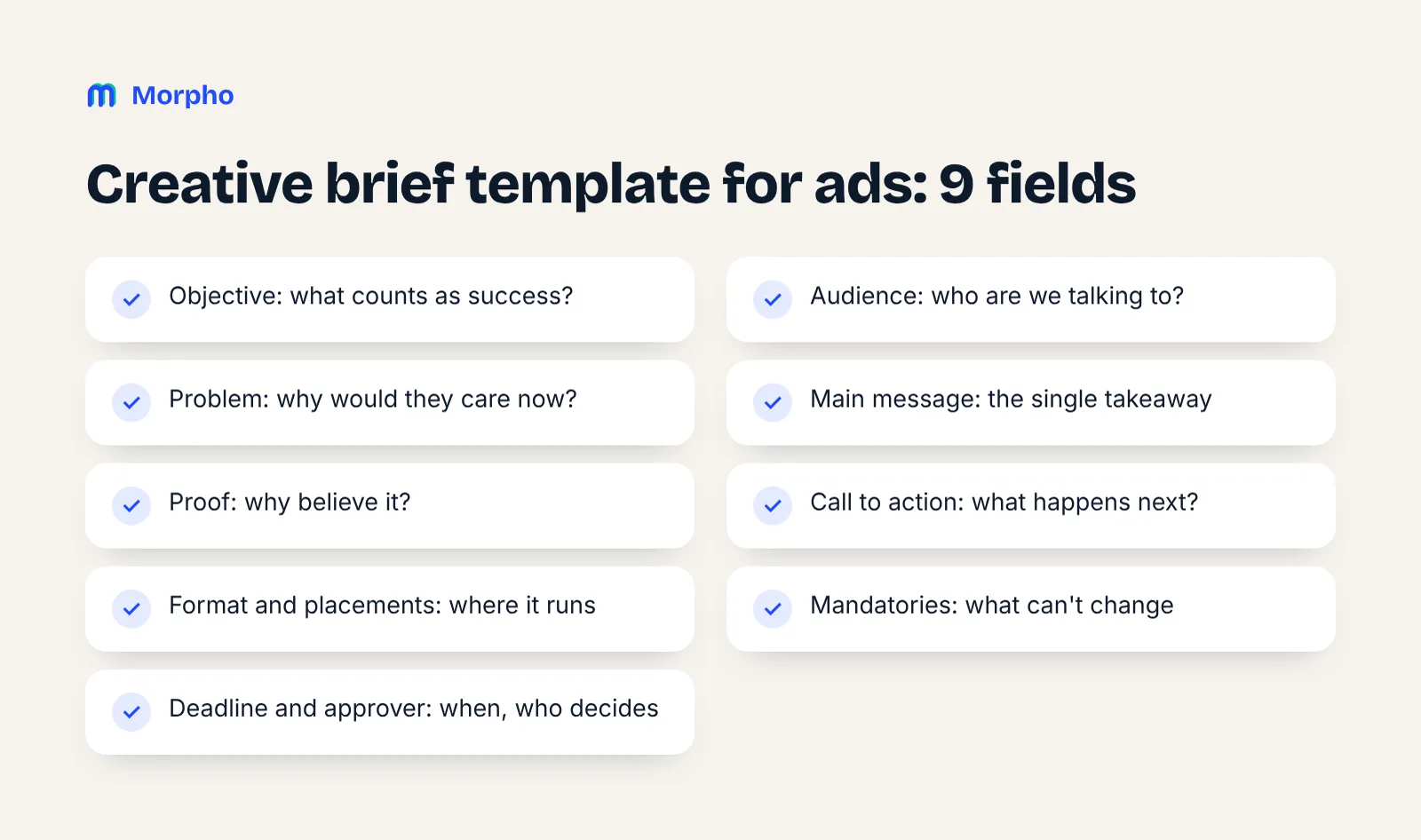
The main message field is the one teams most often get wrong. If you write three benefits there, the copywriter will pick one at random, or worse, try to fit all three into a headline. Write one. The other two can go into a second ad.
Creative brief example: a filled-in ad brief
A creative brief example is easier to copy than a blank form, so here is the template filled in for a hypothetical brand. The brand, product and details are invented for this post.
| Field | Hypothetical example: a coffee subscription |
|---|---|
| Objective | Start a first subscription order from the ad |
| Audience | People who brew coffee at home every morning and buy beans at the supermarket |
| Problem | "Supermarket beans taste flat, and I never know when they were roasted." |
| Main message | Beans roasted the week they reach you |
| Proof | The roast date is printed on every bag; show it in a close-up |
| Call to action | "Start your first bag" |
| Format and placements | One 4:5 static for Instagram and Facebook feed, one 15-second 9:16 video for Reels and TikTok |
| Mandatories | Logo in the top area of the 9:16 frame; no "best coffee in the world" claims; price only on the landing page |
| Deadline and approver | Drafts by Thursday; the founder approves |
Notice what is not in it: no list of every product feature, no brand history, no mood words like "premium yet approachable" without a picture to go with them. A designer reading this brief knows what to show (the roast date), what to say (roasted the week it arrives) and what to avoid (an unprovable "best" claim).
How to write a creative brief in 7 steps
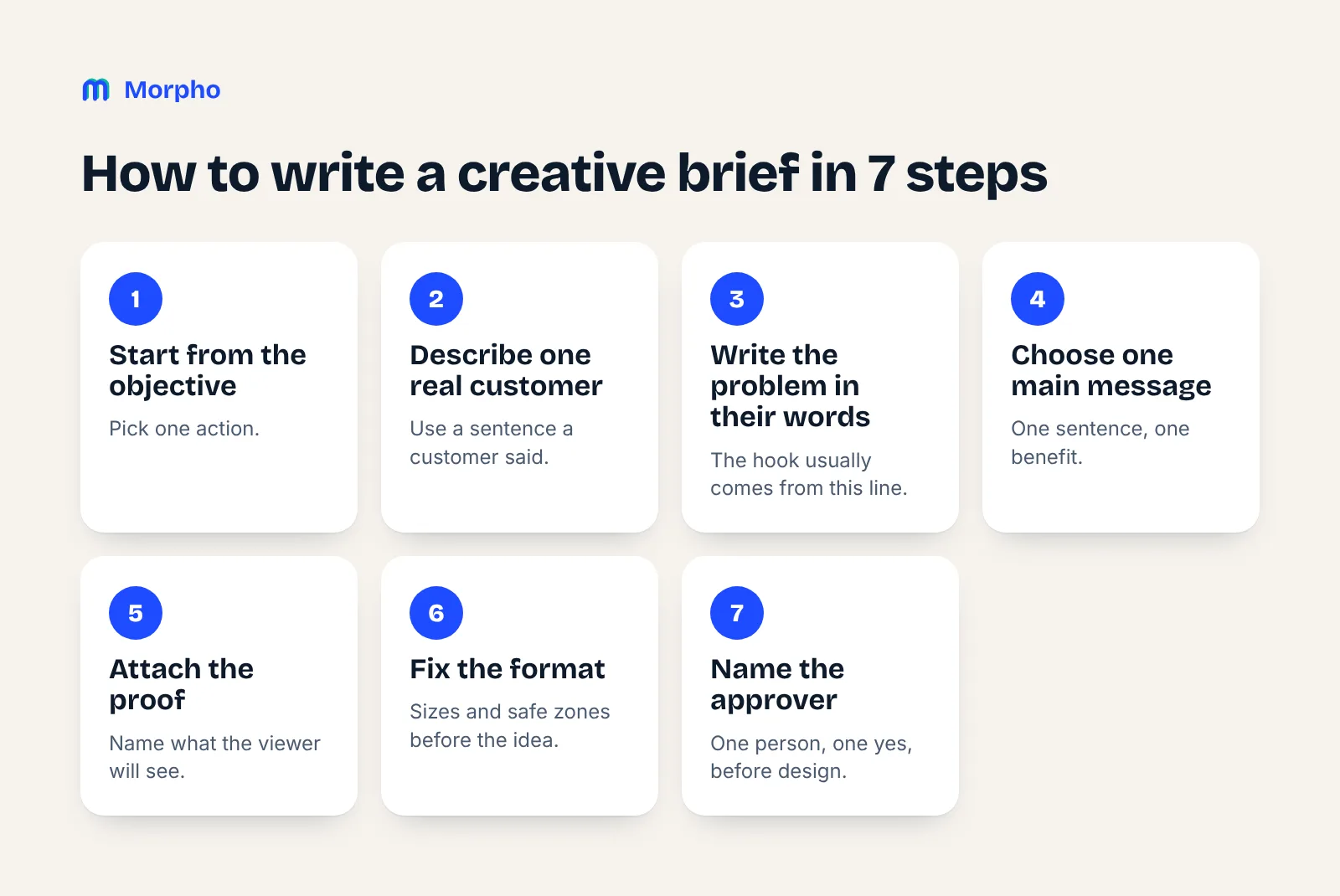
Writing a creative brief takes about as long as the conversation that should come before it. These seven steps keep it to one page.
- Start from the objective. Pick one action. If the honest answer is "awareness and sales", write two briefs.
- Describe one real customer. Use a sentence a customer said in a review, a support ticket or a call. Avoid demographic ranges on their own.
- Write the problem in their words. Quote it if you can. The ad's hook usually comes from this line.
- Choose one main message. One sentence, one benefit. Test it by reading it aloud: if it needs "and", it is two messages.
- Attach the proof. Name the thing the viewer will see: a product shot, a demo, a number with a source, a real review you have permission to use.
- Fix the format before the idea. A 9:16 video with sound off and a 4:5 static need different ideas. Check sizes with the ad image size guide and keep text inside the safe zones.
- Name the approver and get sign-off. One person, one yes, written down, before design starts.
What should an ad creative brief include for Meta and TikTok?
An advertising creative brief for social placements needs three extra lines that a print or website brief can skip: the opening seconds, the safe zones and the sound.
- The first seconds. People scroll fast on Reels and TikTok, so the brief should say what appears before the viewer decides to stay: the product, the problem or a face. Write it as the first scene.
- Safe zones. On a full-screen vertical ad, the app's own buttons and caption cover the top, the bottom and part of the right side. The brief should say that the logo, headline, price and CTA stay in the clear middle. Our free safe zone checker shows those areas for Reels, Stories, TikTok and Shorts.
- Sound. Say whether the ad must work with sound off (captions, on-screen text) and whether there is a voiceover or music.
- Copy limits. Meta shows only the start of the primary text before "See more". Put the main message in the first line; see how to write Facebook ad copy for the fields and the character counter to check length.
- Policy. Health, finance, weight loss and similar categories have extra ad rules. Add a line on claims to avoid; the Meta ad policy checker flags common problems in copy.
For a video, add a simple scene list to the format field: scene, what we see, what we hear, on-screen text. Four to six rows are enough for a 15-second ad.
Creative brief vs. marketing brief vs. campaign brief
A creative brief directs one piece or set of creative; a marketing brief and a campaign brief sit above it. People use the names loosely, so it helps to agree on which one you are writing.
| Creative brief | Campaign brief | Marketing brief | |
|---|---|---|---|
| Covers | One ad or one ad set | One campaign across channels | A product, launch or quarter |
| Main reader | Copywriter, designer, editor | Media buyer, channel owners, creative lead | Leadership, whole marketing team |
| Length | One page | One to three pages | Several pages |
| Key content | Message, proof, CTA, format | Goal, budget, channels, timeline, KPIs | Market, positioning, goals, budget |
| Approved by | One named approver | Campaign owner | Marketing lead |
If you only have time for one, write the creative brief. It is the document that turns into an actual ad.
Common creative brief mistakes
Most bad ads trace back to one of these five gaps in the brief:
- Three messages in the main message field. Pick one; split the rest into separate ads you can A/B test.
- An audience that is only demographics. "25–45, urban" gives the designer nothing to picture. Add a situation and a quote.
- No proof. "High quality" with nothing to show turns into stock-photo ads.
- Format decided after the idea. A concept built for a wide video rarely survives being cut to 9:16.
- No named approver. Feedback arrives from four people in three channels, and nobody knows which version is final.
How Morpho Ads uses creative briefs
In Morpho Ads, an AI ad agency where a team of AI agents works on your brand, there is no brief form to fill in. You tell Morpho, the agency lead, what you want in the chat, for example "two ads for our new filter coffee, one 4:5 and one 9:16". Morpho researches the brand, its products and past creatives, and hands the work to a strategist, a copywriter, an art director and a critic.
A new creative can come back first as a brief for you to check: the angle, the main benefit, the headline, the sub-line, the CTA, the visual direction and, for video, the scenes. You approve it, send it back for revision or cancel it. Only an approved brief goes to design, and a critic agent then scores every design and asks for fixes until it approves. A brief left undecided for seven days is cancelled, and the usage up to that point is charged.
Morpho designs ads and posts; it does not publish or run them. Plans and credits are on the pricing page.
FAQ
What should be included in a creative brief?
An ad creative brief should include the objective, the audience, the problem, one main message, the proof, the call to action, the format and placements, the mandatories, and the deadline with the approver's name. Some templates list seven parts by merging problem into audience and proof into message. The number matters less than having one clear answer per field.
How long should a creative brief be?
One page. A creative brief is read by people who will make the ad, often more than once, so every line should change what they make. Background research, personas and brand history can live in separate documents that the brief links to.
Who writes the creative brief?
Usually the marketer, account manager or strategist who owns the result, with input from the client or product owner. The creative team should read it and ask questions before agreeing to it, and one named person approves it before work starts.
Is there a free creative brief template?
Yes. The nine-field template in this post is free to copy, and it works in Google Docs, Notion, a project ticket or a chat message. If you want the finished ads too, Morpho Ads has a free tier: describe the ad in the chat, and a new creative can come back first as a brief for you to approve.
This article was prepared with the help of AI; facts and sources were checked before publishing.
Make your ads in one conversation.
Connect your site and write what you need. An AI team makes on-brand image ads, videos and social media posts; you get the version that passed quality control.
Try it free